Wednesday, April 4, 2012

Kentucky Wins Championship


(Picture: New York Daily News).

As was widely expected, Kentucky won college basketball's National Championship on Monday night, overpowering Kansas 67-59. Kentucky now owns eight overall NCAA Championships in men's basketball. Interestingly, controversial head coach John Calipari got his first NCAA Championship by leading the "blue blood" Wildcats past Bill Self's "blue blood" Kansas Jayhawks (Kansas and Kentucky--along with North Carolina, Duke, Indiana and UCLA--are frequently referred to as college basketball "blue bloods" because, like the old East Coast WASP blue blood elites who dominated the American institutions of yesteryear, they're the privileged, elite ruling class of college basketball). In 2008, Calipari's Memphis Tigers narrowly lost in the NCAA Championship game to Kansas and Self.

Drive and Dish editors were at a wedding when the Final Four games were played on Saturday. As such, we missed Kentucky's win over Louisville, and only managed to catch the last ten minutes of Kansas' win over Ohio State. Our editors got off a plane and only returned to the Drive and Dish viewing room in time to catch the second half of Monday night's Championship game. So we don't have much to say about the game itself.

We do, however, think that college basketball is very watered down these days, and although we would have preferred to have been able to watch the Final Four, we weren't particularly thrilled about the prospect of watching Kansas and Kentucky in the Championship game. John Calipari has put together an impressive assortment of NBA-ready talent on each of his three Kentucky teams (Calipari left Memphis for Kentucky in 2009). But the main players on his teams only stick around college for one year before they bounce to the NBA. Thus, watching Kentucky has more or less become akin to watching the NBA Rising Stars Challenge.

Sorry, but it's just hard to get excited about that. We'd be hard-pressed to disagree with the following commentary from the Washington Post/Bloomberg News:

In a very real sense, the ending of this game and this season was a microcosm of what college basketball is in 2012. As soon as the final buzzer sounded, the Super Dome was filled with sound, not from celebrating fans, but from the Hollywood-like pyrotechnics the NCAA insists on bombarding people with in its attempts to glitz up an event that doesn't need to be glitzed up.

Nowadays, though, all the sound and noise fits because the national title game has the feel of an NBA all-star game, and most of the players who make it to the Final Four dream first of that game and the billboards and shoe deals that come with it rather than the game Kentucky won on Monday night.

Perhaps it is time for the NCAA to change it's cheesy post-championship theme song. Instead of "One Shining Moment," a new song: "One Moment and Done," words and music by Calipari, might be more fitting.

Sunday, March 25, 2012

Final Four: Kentucky, Louisville, Ohio State, Kansas


The Final Four is set. Kansas, Kentucky, Ohio State and Louisville won their Regionals and advance to next weekend's Final Four in New Orleans. Unlike 2010 and 2011, when mid-major "Cinderellas" Butler and Virginia Commonwealth shocked the world and advanced to the Final Four, the 2012 Final Four field is comprised entirely of the usual suspects.

Louisville competes in the Big East Conference, but geographically, the East Coast is entirely shut out. Three of the four teams come from schools within 100 miles of Cincinnati, Ohio. The fourth, Kansas, comes from the heart of the heartland. It's an entirely Midwestern and Mid South Final Four.

Syracuse was the top-seeded team in the Tournament, but Syracuse alumni who work in the national sports media (in other words, most of the national sports media) will have to content themselves by pulling for Louisville to defend the Big East's honor. Casual fans who've enjoyed rooting for Cinderella "Davids" (i.e., Butler) to knock off college basketball "blue blood" "Goliaths" (i.e., Duke and Connecticut) in the last two NCAA Championship games will be faced with the likelihood of watching "blue blood" Kentucky play "blue blood" Kansas for the right to hand yet another NCAA Championship banner in the rafters.

On a more personal level, Drive and Dish editors will be stuck at a wedding in south Georgia while Saturday's games are being played. But if we get the chance, we may try to hit Interstate 10 on Sunday morning and see if we can get to New Orleans by evening. If so, we'll be hanging around the Final Four for Monday's Championship game.

Thursday, March 15, 2012

Drive and Dish 2012 NCAA Tournament Bracket

Drive and Dish was launched one week before the start of the 2007 NCAA Tournament. In 2008, we began publishing our handwritten NCAA Tournament brackets. The night before our first brackets appeared, Mark Buckets and yours truly spent the wee hours deliberating over our picks in a then-24 hour Kinko's in the western suburbs of Chicago. Mr. Buckets abruptly retired from sports blogging during Duke's upset loss to West Virginia in the second round of that year's Tournament. He came out of retirement to pen a post or two later in the week, but left blogging for good after the 2008 Final Four.

Drive and Dish Senior Editor Trashtalk Superstar took sole responsibility for handwriting and publishing the annual Drive and Dish NCAA Tournament bracket in 2009. Like a monk who spent years copying the Bible by hand during the Dark Ages, Mr. Trashtalk devoted himself to handwriting and publishing the Drive and Dish brackets for the remaining years.

The 2010 Drive and Dish NCAA bracket was particularly noteworthy. Drive and Dish eschewed the conventional wisdom (we were among the few who didn't pick Kansas that year) and correctly predicted that Duke would earn head coach Mike Krzyzewski his fourth NCAA Championship. To be sure, we never envisioned that the Blue Devils would meet unheralded Butler in the Championship game, but we deserved some credit for what was (at the time) a bold pick. Believe it or not, virtually nobody picked Duke to win it all that year.

Our 2010 Duke pick was reminiscent of when we picked Florida to win its second consecutive NCAA Championship in 2007, even though the defending champs' lackluster regular season performance had caused most of the "experts" to be Gator skeptics (we didn't publish our brackets that year, so readers will have to work their way through bullet points to find the Florida Championship prediction).

Drive and Dish picked Duke to win it all again in 2011, even though the Blue Devils lost a few key starters from the 2010 Championship team to graduation. We ended up being wrong: Duke fell short and Connecticut came out of nowhere to win head coach Jim Calhoun his third NCAA Championship.

This year, we ended up with North Carolina beating Duke in an NCAA Championship game for the ages. To be clear, we don't actually think the game will be that good. North Carolina should waltz to the Championship . But if our prediction comes to pass, the game will be deemed a "game for the ages" simply due to the novelty of having the two biggest conference rivals in college basketball face each other for the third time this season while playing for the championship.

Of course, our 2012 bracket should come with the following disclaimer: yours truly hasn't had a TV for two years. So like last year's brackets, the Drive and Dish 2012 brackets have been completed despite the fact that Drive and Dish writers' exposure to college basketball in the 2011-2012 season has been limited to internet viewing of select games and to catching a few minutes of games here and there while out and about (come to think of it, maybe that's why we didn't see Connecticut coming last year).

Our 2012 bracket:


Normally, we list several things to watch for below our brackets. But this year, since we haven't seen many games, there really isn't much that we can say with much authority. But we have seen St. Bonaventure play and we think they could surprise people. Of course, they play Florida State in the first round, and the Seminoles have beaten Duke and North Carolina. A few more things:

* Everybody seems to have Kentucky winning it all, but we're skeptical (as we always are of John Calipari's teams). Kentucky has the talent, but do they have the mental toughness and experience that teams with upperclassmen typically have? Toughness and experience are two essential ingredients that National Championship teams must have.

* We picked Virginia Commonwealth to beat Wichita State (primarily because we're so sick of witnessing Illinois fans salivate over VCU coach Shaka Smart that we figure his team will go on a tear that forces us to put up with two weeks more of Illini fans' slobbering), but Wichita State is good enough to make it to the Sweet Sixteen, and maybe beyond.

We've seen Wichita St. a couple times this year and have been pretty impressed. Gregg Marshall is an outstanding coach. He turned tiny Winthrop into a perennial NCAA Tournament participant before bolting for Wichita, and he's got the Shockers' on the national map. Marshall will be pursued by several BCS conference schools that have coaching openings.

* We picked New Mexico State to surprise Indiana. Indiana should win the game, but NMSU is the type of off-the-radar team that can give the big boys all kinds of trouble in the first round Tournament games.

* Nobody has impressed us in 2012 more than Notre Dame. Most of the games we managed to watch online were Fighting Irish games. This was supposed to be a rebuilding year for the young Irish, but when senior Tim Abromaitis was lost for the season after tearing his ACL, it looked like the season could turn out to be a disaster. But Mike Brey's team knocked off ranked Big East team after ranked Big East team and wound up back in the Big Dance ™.LinkBrey won national coach of the year in 2011. He probably deserves it even more this year.

That said, we have Xavier beating Notre Dame in the first round. We think Xavier's toughness could give the Irish trouble.

* Ohio University is a dark horse team that a lot of people like to make some noise. Head coach John Groce is a rising star in the game. If the Bobcats make a run in the Tournament, he'll have plenty of opportunities to go to bigger name schools (although he probably won't find a nicer campus than the one where he works now -- Ohio University's campus is gorgeous).

We don't think Ohio will beat Michigan though. The Wolverines aren't very big, but they're tough and they can score. We do, however, expect Ohio to give Michigan a run for their lives. But in the end, coach John Beilein's Wolverines should pull it out and advance to play another day.


Thursday, March 8, 2012

Nerds vs. Jocks: Mapping Out NBA Shots Taken Since 2006

In the classic 1984 comedy Revenge of the Nerds, the affable, but tormented nerds of the Lambda Lambda Lambda fraternity marshal their superior brainpower to get last laugh on their dumb jock tormentors from the Alpha Beta house. In the years since Revenge of the Nerds became a hit, the "nerds outsmart the dumb jocks" storyline has seemingly been recycled ad infinitum.

Keith Olbermann essentially built his sportscasting career -- and helped build the ESPN SportsCenter empire -- by taking a page from the Revenge storyline: nerdy ethnic oddball uses his wit and verbal acuity to enact revenge for a lifetime of being tormented, "wedgied" and stuffed into lockers by cool jocks at school poke fun at the college and professional athletes he covers (Olbermann co-hosted SportsCenter with Dan Patrick on ESPN prior to his better-known career on MSNBC as America's favorite foaming-at-the-mouth liberal political talking head).

But ESPN didn't retire the "nerds outsmart the dumb jocks" schtick (or at least the "clever non-athlete outsmarts the big dumb ex-jock" schtick) when Mr. Olbermann was shown the door in 1997. ESPN radio -- and other sports talk stations from coast to coast -- regularly employ the oft-drawn-upon formula that pairs a quick-witted and sardonic "smart guy" with a big, "dumb" former professional athlete (or at least one who plays "dumb"). The joke is that the smart guy who never played sports actually knows a lot more about sports than the dumb buffoon who played the game!

These days, the "nerds know sports better than jocks" narrative has become the conventional wisdom, thanks in large part to the runaway success of Moneyball.

The 2011 film Moneyball, starring Brad Pitt, is based on Michael Lewis' 2003 bestselling book on baseball economics, Moneyball. Both book and film tell the story of Oakland Athletics' General Manager Billy Beane, a former major league player who turned to advanced statistical analysis -- known as sabermetrics -- to evaluate players when he found himself saddled with a limited budget upon taking over as the Athletics' GM.

Beane's early A's teams won on the cheap. So he was touted as a genius and his abandonment of traditional methods of player evaluation in favor of advanced numbers crunching became the order of the day in Major League Baseball. In practically no time, all the other teams revamped their player evaluation processes to incorporate Beane's statistical models.

That Mr. Beane was no nerd before he turned to statistics -- a former major league player and scout can hardly be called a nerd -- is irrelevant. So, apparently, is the fact that the A's haven't returned to the playoffs since 2006. We're living in the Moneyball era. Statistics rule and number crunching nerds are ascendant: the pencil-necked pencil pushers and their equations have once-and-for-all triumphed over the wisdom of the dumb jocks (or so the smart people say).

Now it seems like every nerd and numbers guy under the sun is citing statistics to show that they know more than the dumb jocks. And it's not just baseball: everybody from the former star University of Chicago and Harvard Law professor and current Obama administration Regulatory Czar who (allegedly) debunked the concept of the "hot hand" in basketball (multiple academic studies exist which purport to debunk the myth of the hot hand) to the FedEx deliveryman and basketball statistics enthusiast who predicted that Jeremy Lin would be a star NBA point guard back in 2010 is seemingly in the game.

So it makes sense that the lefty political nerds at Salon would get into the game too: "What Geography Can Teach Us About Basketball":

The annual Sloan Sports Analytics Conference, created in 2006, has become something like Bonnaroo for sports nerds. And if there was a breakout star at this year's gathering, held at MIT this past weekend, it may have been Kirk Goldsberry, an assistant professor of geography at Michigan State (and currently a visiting scholar at Harvard). At Sloan, Goldsberry—whose dissertation "investigated real-time traffic maps" and who has also used geography to examine "access to nutritious foods in urban areas"—considered the ways that sophisticated statistical mapping can illuminate the game of basketball, in a paper called "Court Vision: New Visual and Spatial Analytics for the NBA."

You only have to glance at the maps Goldsberry produced to know that stat-friendly teams will pounce on these things. As the New York Times basketball blog Off the Dribble noted over the weekend, "about a third of the league’s arenas have recently installed camera systems that capture and log the position of every player on the court 25 times a second." As a result, many teams now have incredible amounts of data they can visualize in some of the ways Goldsberry suggests.

For the map above, for instance, Goldsberry divided roughly half an NBA court (from the baseline to just past the 3-point line) into 1,284 "shooting cells." Then he plotted every shot taken in an NBA game from 2006 to 2011, and color-coded the results. The areas which yielded the most points per shot appear near the red end of the color spectrum; those that yielded the fewest are at the blue end.

If you've read anything about scoring efficiency in basketball, the resulting image will not surprise you (though its elegance is striking). But it conveys far more quickly and powerfully than a set of numbers can what kind of shot distribution an NBA team should be going for, generally speaking.


The takeaway: If you ever needed confirmation that the mid-range game is a relic of the past, you've got it now. Most shots taken in the NBA from 2006 to 2011 were either layups, dunks or three pointers. The baseline jump shot no longer exists.

Gone are the days when post players like Adrian Dantley, Kevin McHale and Mark Aguirre would beat you with post moves inside, and then beat you with post-up turn around jumpers when you tried to push them off the block. Gone too is Karl Malone's 15-20 foot jumper that forced opposing big men leave the lane and chase him out into no (big) man's land.

Scottie Pippen's bank shots from between the elbow and the baseline? Yeah, they're gone too. But if you've been paying attention to the NBA over the last few years, you probably already knew as much.

Kevin Garnett is one player who still takes a lot of mid-range shots (Garnett idolized Dantley and McHale while growing up), but he's a definite outlier. Kobe Bryant takes a lot of mid-range fade aways, but since he shoots whenever he has the ball (regardless of where he is on the court), it doesn't count for much against the larger statistical pattern.

The NBA has gone the same way that college basketball has gone over the last 15 years: nobody wants to take a shot that's not a layup, a three pointer or a dunk.

Rick Pitino changed college basketball when he was coaching at Kentucky in the early and mid 1990s. Pitino decided that shots outside of the lane, but inside of the three point line were a waste of time. He figured that if you're going to take an outside shot (any shot taken from beyond 5-10 feet from the basket), you might as well take one that's worth three points if it goes in, rather than two.

So that's what Pitino's Kentucky teams did. And after they made back-to-back Final Fours in 1996 and 1997 (which included a National Championship in '96), other teams around college basketball started adopting a similar style.

The mid-range game disappeared from college basketball in the late 90s. It took a little while longer for it to disappear from the NBA, but the disappearing act is all but complete now.

Sunday, March 4, 2012

Northwestern Gets Closer to First NCAA Tournament, Michigan State Loses Key Player to Injury

Northwestern kept its NCAA Tournament hope alive beating Iowa 70-66 in the last game of the regular season today. Northwestern has never been an NCAA Tournament participant. Last week, Drive and Dish examined the recent history of Northwestern basketball and the significance of the Wildcats' pursuit of their first NCAA Tournament bid.

Northwestern now has an 18-12 overall record, and an 8-10 record in Big Ten conference play. As we explained in last week's aforementioned Drive and Dish post, we weren't optimistic about the Cats' chances for getting their first NCAA Tournament invitation after they fell just short of upsetting No. 10 Ohio State on Wednesday. But with the end-of-season collapses of other Big Ten teams that were on the NCAA Tournament "bubble" (we're looking at you, Illinois, Minnesota and Iowa), NU's chances quickly got a lot better.

Northwestern finished the regular season in seventh place in the Big Ten. Since the Big Ten has been widely regarded as the most competitive conference in college basketball this season, it's likely that seven Big Ten teams will get into the NCAA Tournament. If Northwestern beats Minnesota in the first round of the Big Ten Tournament later this week, they will almost certainly be rewarded with their first Tournament invitation.

Drive and Dish believes that Northwestern could be dangerous in the NCAA Tournament. Northwestern has run the famed Princeton offense since Bill Carmody implemented it when left Princeton to become the Wildcats' head coach in 2000. The Princeton offense is notoriously difficult for opposing teams to prepare for, and teams that run it have had a great deal of success playing the role of "Cinderella" in the NCAA Tournament.

This year, Drive and Dish wouldn't be surprised to see Northwestern wearing glass slippers in the "Big Dance."

The news isn't as good for Michigan State though. Star freshman small forward Branden Dawson tore his ACL in today's 72-70 loss to Ohio State. Dawson will undergo reconstructive knee surgery and 6-9 months of rehabilitation.

Obviously, he won't be able to play in the NCAA Tournament.

Until today, Drive and Dish had expected Michigan State to be a serious contender for the 2012 National Championship. We thought they had an excellent chance to make it to the Final Four, and at least a decent shot at giving head coach Tom Izzo his second Championship. But Dawson's season-ending injury makes that considerably less likely.

Wednesday, February 29, 2012

Road to First NCAA Tournament Berth Gets Tougher for Northwestern

Northwestern entered the 2011-2012 season with high hopes of earning its first ever trip to the NCAA Tournament. After tonight's nerve-wracking 75-73 loss to No. 10 Ohio State, Northwestern will likely once again find itself on the outside (of the Tournament field) looking in.

If ever there was such thing as a "must win" game, tonight's contest with Ohio State represented that for Northwestern. The Wildcats came into the game clinging precariously to the NCAA Tournament "bubble." When the game tipped off, they had a 17-11 overall record, with a 7-11 record in the rugged Big Ten. The main credential on Northwestern's NCAA Tournament resume was an impressive mid January win over then-No. 6 ranked Michigan State. But after that, the Northwestern resume was a bit thin: their only other "big" win was an early February win at Illinois.

That's why tonight's home finale against Ohio State was so big. With an upset over the No. 10 Buckeyes, Northwestern would have had two signature wins over opponents ranked in the top ten of the AP Top 25. Even with a win, Northwestern still probably would have needed to beat Iowa this weekend and win a game in the Big Ten Tournament to get into the NCAA Tournament. But a late-season upset win over Ohio State would have made Northwestern's case for receiving a bid to the NCAA Tournament considerably more credible.

That's also why Jared Sullinger's tie-breaking and game-winning turnaround bank shot with 3.1 seconds was so crushing. The Wildcats overcame a 13 point defecit late in the second half to tie the Buckeyes in the game's final seconds. Momentum was on the 'Cats' side and they were that close to taking the game into overtime (at home, no less -- overtime is usually kind to the home team); Sullinger's game-winner was dagger that probably ended whatever chance Northwestern had of making its first appearance at the "Big Dance."

However dispiriting tonight's loss may be for the Northwestern basketball program and its fans, a brief look back at the road that led Northwestern to the NCAA Tournament "bubble" provides some needed perspective. Overall, Northwestern basketball is a success story. The once-perpetually moribund Wildcat basketball program has slowly and quietly become a legitimate second-tier competitor in the Big Ten conference. Head coach Bill Carmody was originally hired away from Princeton in 2000 to install the famed "Princeton offense" at Northwestern, and thus, give the ever-undermanned Wildcats at least a fighting chance to a "hang" with their athletically superior Big Ten rivals. In recent years, however, Carmody has been able to attract significantly better players to the highly-selective Evanston, Ill., school. As a result, the Wildcats have gotten a lot better: they've made three straight N.I.T. appearances, and they put together back-to-back 20 win seasons in 2010 and 2011.

The one big thing they haven't done yet, though, is make it to the NCAA Tournament.

All the gradual improvement of the Carmody era has been great (however deliberate and plodding the Wildcats' style of basketball may be), but Northwestern basketball won't have officially turned the corner and won't officially be on the college basketball "map" until the Wildcats take the floor in the NCAA Tournament. Things, however, looked quite promising prior to the start of the 2011-2012 season: with what the "experts" expected to be a "weak" Big Ten (how wrong they were!); with the attendant expected "wide open" open Big Ten race; and with four returning starters coming into 2012 -- including leading scorer John Shurna -- 2012 was supposed to be the year.

Obviously, things didn't exactly work out as expected. The Big Ten turned out to be the strongest conference in Division I college basketball. Outside of Penn State and Nebraska, every Big Ten team has, at various points in the season, looked like a potential NCAA Tournament invitee. Northwestern had an easy non-conference schedule and subsequently raced out to a 10-2 non-conference record (which included wins against LSU, Seton Hall and Georgia Tech). But the rough-and-tumble Big Ten brought the Wildcats back to Earth a bit, and despite the aforementioned impressive wins over then-No. 6 ranked Michigan State and at Illinois, Northwestern limped into tonight's home finale against Ohio State with a 7-9 conference record and in desperate need of a win to keep their NCAA Tournament hopes alive.

They're now 17-12 overall, 7-10 in the Big Ten. And barring some "bat out of Hell" run in the upcoming Big Ten Tournament, Jared Sullinger's game winning shot likely relegated them to their fourth consecutive N.I.T.

(Photo: Jared Sullinger game-winning shot, courtesy of Lake the Posts).

Monday, February 20, 2012

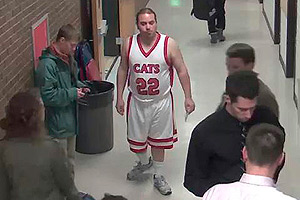
Freak: The "Piggyback Bandit"

Drive and Dish has heard from several readers who wonder why we haven't weighed in on the strange tale of Sherwin Shayegan, the 28 year old man who shows up at high school basketball games across the Western United States, gains access to the teams' benches and cons his way into getting piggyback rides from players. He's known as the "Piggyback Bandit," and his story has gone viral over the last several days.

ASSOCIATED PRESS/ESPN

HELENA, Mont. -- The stocky man showed up in a basketball uniform for a game at Century High School in North Dakota. Players and coaches assumed he was a fan who had come with another team, so nobody objected when he began to pitch in around the bench.

"He helped lay out uniforms, got water. He even gave a couple of kids shoulder massages. Creepy stuff like that," said Jim Haussler, activities director for the Bismarck Public School District.

After the game was over, the man joined the winning team on the court and asked if he could get a piggyback ride. One bemused player gave it to him.

Sherwin <span class=
AP Photo/Bismarck SchoolsSecurity footage taken this month at Century High School in Bismarck, N.D., shows a man identified as Sherwin Shayegan of Bothell, Wash., known as the 'piggyback bandit.'

"He makes himself appear as if he's limited or handicapped. I think he plays an empathy card, so to speak," Haussler said. "We didn't realize what we were dealing with until several days later."

What they were dealing with the night of Feb. 4 was the Piggyback Bandit -- Sherwin Shayegan of Bothell, Wash., a 28-year-old man who ingratiates himself with high school sports teams, then hoists his 5-foot-8, 240-pound frame onto the backs of the student athletes.

Shayegan's antics stretch back to 2008 and had been mainly confined to Washington and Oregon. But since last fall, he has worked his way east to Montana, North Dakota and Minnesota, leaving a trail of befuddled athletes in his wake.

Shayegan has asked for piggybacks, attempted to pay for piggybacks and just sprung one upon an unsuspecting kid. He favors basketball games, but he also has leapt onto hockey, soccer and football players.

He has pretended to interview athletes for a term paper, acted as a team manager or just tried to blend in with the crowd for a piggyback payoff.

Why he does it is unclear, as is who came up with the "Piggyback Bandit" nickname that now follows him wherever he goes.

"Why he does it is unclear?" No it's not. It seems pretty obvious that he has some kind of "piggyback" fetish, and that he receives some measure of sexual gratification -- however strange it may be -- from jumping on young athletes' backs.

The only thing that's "unclear" is whether or not the kids whose backs he jumps on feel something poking them in the back.

Well, that and what his parents were smoking when they named their kid "Sherwin."

Sherwin Shayegan.jpg (Photo: mugshots.com)

More:

Little is publicly available about Shayegan's background, other than his arrest record. Phone numbers listed for relatives rang unanswered, and messages left were unreturned.

One person who has known Shayegan for several years is Mike Colbrese, the executive director of the Washington Interscholastic Activities Association. Colbrese said he became acquainted with Shayegan about seven years ago, when Shayegan was a common fixture at games and used to ask for work as a waterboy in state high school basketball tournaments.

"He would just wander around. You wouldn't see him interacting with coaches and players when we were first aware of him," Colbrese said.

Nobody knew where he lived or what he did, Colbrese said. Eventually, he was viewed as an eccentric nuisance who generally bothered staff for jerseys or for a role at games.

Things changed in 2008, when Joel E. Ferris High School of Spokane won that year's state basketball tournament and Colbrese spotted Shayegan hanging around the locker room after the game.

"He was jumping on players' backs after they showered and came out of the locker room," Colbrese said.

It sounds as if he's been attracted to high school basketball players for a while, but that he had to spend about three years working up the courage -- or polishing up his "challenged" water boy schtick -- to escalate his con to where he could get close enough to the young athletes to jump on their backs.

It seems like a lot of people are approaching the "Piggyback Bandit" story as if it's some kind of funny, off-the-wall tale about an extremely eccentric, oddball dude. But in our opinion, it's really a story about some guy who's just a seriously fu**ed up pervert.

The cat's out of the bag now, though. The guy's strange compulsion has made him into something of an internet star/"meme." So he's famous, baby! But so was Brian Peppers.

This much is certain -- now that Mr. Shayegan's story is known in all 50 states, it's going to be that much more difficult for him to pull off his "Piggyback Bandit" antics at high school basketball games (and to find/maintain gainful employment).

It will be interesting to see if he keeps trying.

Thursday, February 16, 2012

Illinois Loses "Must Win" Game to Purdue, End of Bruce Weber Era Now In Sight

Illinois entered last night's game with Purdue in desperate need of a win. And frankly, that's quite the understatement. A more accurate portrayal of the pressure cooker that the Fighting Illini and their embattled head coach, Bruce Weber, entered when they stepped onto the court at Illinois' legendary Assembly Hall would include the following disclaimer: if the Illini had any hopes of getting off the proverbial "schneid;" of salvaging the 2011-2012 season; or of remaining in contention for an NCAA Tournament berth and preventing the eventual off-season firing of their head coach, they simply could not lose at home to Purdue.

But lose at home to Purdue they did, 67-62 to be exact.

And now the wheels have officially come off the Bruce Weber era at Illinois.

With a first-year Athletic Director now calling the shots in the Illinois athletic department (and fresh off of firing football head coach Ron Zook), Bruce Weber came into the season knowing that he had almost no room for error. First year Athletic Directors lick their chops at the prospect hiring their own coaches; any coach who ends up working under new a A.D. knows that he's got a giant target on his back. The only way a coach in that situation usually keeps his job is by winning so much that it's impossible for the A.D. to pull the trigger.

So with the team in a tailspin, and with the knowledge that both the 2011-2012 season and their coach's job were hanging in the balance, Illinois went into last night's game with no other recourse than to win.

But they didn't.

So their NCAA Tournament hopes are all but over and the noose has officially been hung around their head coach's neck.

And clearly, he knows it:


Bruce Weber's post-game press conference is depressing. He appears to be completely defeated. Weber is a good coach, and he's had some great successes at Illinois. But he knows that he's a dead man walking.

Weber's post-game press conference might as well have been his post-firing farewell. He laments having "mollycoddled" his players this season in attempt to win a few more games, rather than having instilled discipline and an overall culture of winning. Interestingly (though not surprisingly to anyone who's been paying attention), Weber's lamentations confirm what Drive and Dish suspected were problems plaguing Weber's program way back in 2008.

A little background:

In his second season as head coach at Illinois, Bruce Weber's Illini steamrolled their way to the 2005 Final Four, where they eventually lost to North Carolina in the NCAA Championship game. But it took Weber several years to break through with Chicago area recruiting circles, and recruiting hit a four year rough patch following the '05 Final Four.

By the time the key players from Weber's 2005 Final Four team had all moved on -- Deron Williams and Luther Head ended up being NBA first round draft picks in '05; Dee Brown and James Augustine graduated in 2006 -- it had become apparent to anyone who had eyes that the cupboard was bare in Champaign-Urbana.

That didn't prevent Illini fans' expectations from being raised higher than Mt. Everest though. And Weber's early success only made his recruiting misses -- and the attendant drop-off in talent -- that much harder for Illini fans to swallow.

By 2009, Weber was finally starting to attract some decent players to his program, but his earlier lean recruiting years left his teams with a perpetual dearth of talented upperclassmen. Unfortunately, that forced the otherwise conservative Weber to rely heavily on the contributions of freshmen and sophomores, many of whom were thrown into the fire before they were truly ready.

So things were up and down following Bruce Weber's early glory years (2004-06). Drive and Dish never expected the 2007 Illini to play in the post season. We thought that Illinois' talent level was so low that year that the team would need a near-miracle season just to get into the N.I.T. But somehow, the team that probably had the least talent of any team in the Weber era managed to grind and muck its way to the NCAA Tournament -- even if it was accomplished by the heavy use smoke and mirrors.

Many Illini fans started to lose confidence in Weber that year (he'd been considered a genius by most Illini fans in 2005 and 2006), but we were impressed that he managed to do so much with so little ... though it certainly wasn't pretty, or fun to watch.

The 2008 season turned out to be a disaster for Weber's Illini, though. When they were in desperate need of a win to get off the NCAA Tournament "bubble," they got the Jamar Smith DUI/car crash fiasco instead. The fact that Smith and teammates went out and got s**t-faced drunk -- Smith's blood alcohol content was measured at over 2.0 -- the night before a "must win" game probably says as much about the state of the program at that time as anything that happened on the court. After Smith incident, the 2008 team tanked, and ultimately missed the post season altogether.

Illinois basketball rebounded in 2009, however, and what had originally looked to be a rag-tag assembly of "try-hard" overachieving upperclassman perimeter players and underfed, reed-thin underclassman big men, turned out to be the surprise upstart of the Big Ten. Illinois' nails-tough senior guards led the Illini back into the upper reaches of the Big Ten and back to the NCAA Tournament.

Predictably, after the surprisingly good 2009 effort, expectations were once again high for Bruce Weber and Illinois for the 2009-10 season.

But Bruce Weber had loosened the reins following the gruelingly ugly of campaigns of 2007-08, and with the absence of the toughness and leadership that senior guards Trent Meacham and Chester Frazier had provided in 2009, the 2009-10 Illini lacked -- you guessed it! -- toughness, discipline and leadership.

They ended up missing the NCAA Tournament and losing at home to Dayton in the N.I.T.

In 2010-2011, Illinois added the most heralded recruiting class of the Bruce Weber era to the returning upperclassmen who had so underachieved in 2010. Illini probably fans should have waited to see how the team would come together before they allowed their expectations to get out of control, but the Illini Nation was just so giddy over the fact that they finally had a big time recruiting class that it was virtually impossible to for cooler heads to prevail. Things really got wild after Illinois ran highly-rated North Carolina off the Assembly Hall court after Thanksgiving in the ACC - Big Ten Challenge. But predictably, as the season wore on, the Illini failed to live up to their fans' lofty expectations (unrealistic though those expectations may have been).

Illinois had more ups and downs than a bipolar manic depressive in 2011, and the senior-laden team spent much of the season in a familiar place -- the NCAA Tournament bubble. The Illini stumbled into the NCAA Tournament, but once there, they dismantled former Illini coach Lon Kruger's UNLV squad in the first round ... before being dismantled themselves by Kansas in the next round (Kansas, of course, was coached by Kruger's successor and Weber's predecessor at Illinois, Bill Self).

As the roller coaster 2011 season wore on, a significant percentage of Illini fans turned on Bruce Weber. By the time the season ended, most fans were happy to move on to 2012. The seniors who graduated in 2011 had comprised the core of two famously underachieving Illini teams. Bruce Weber had spent 2011 on the hot seat, but there was a feeling in much of Illini land that things might be better in 2012, if only through the process of addition by subtraction (of the departed underachieving seniors).

But the Illini 2011-2012 would return only two players who had played significant minutes in 2011, and there was absolutely no evidence to suggest that Weber's young and inexperienced team would fare particularly well in a league as stacked from top to bottom as the Big Ten.

After the graduation of four key seniors from the 2011 team (disappointing though that team may have ultimately been), and with the infusion of six freshmen and a senior transfer (that's seven new players!), it should have been clear to everyone that 2011-12 was going to be a rebuilding year for Bruce Weber's Illini. There were probably even residents at the Chicago Lighthouse For the Blind who could see as much.

Interestingly, many Illini fans did not have unrealistically high expectations at the beginning of the 2011-2012 season (for once). Illini fans were generally eager to see how all the new, young faces would fare once they took the court, and if you asked them, most fans would probably have told you that they just hoped that their young Illini would be competitive, and would improve as the season progressed .

But that changed pretty quickly: the Illini got off to a fast non-conference start, and 7'1" sophomore center Meyers Leonard blew up after dominating Gonzaga's Robert Sacre in front of a national television audience in December. So once again, expectations soared to the heavens.

Predictably, Big Ten conference play brought the rebuilding Illini back to Earth (although the Illini did upset two teams ranked in the Top Ten, Ohio State and Michigan State).

Anyone with a shred of knowledge about college basketball should have expected the young 2012 Illini to be a perpetual work in progress. Young teams like Illinois are usually "up and down": they usually win some games that they probably shouldn't win, and lose some games that they probably shouldn't lose.

And that's exactly what happened. But once the fans let their expectations start running wild, everybody seemed to forget that 2012 was supposed to be a rebuilding year. Thus, with each close win and with each disappointing loss, the Illini Nation turned their increasing ire to Bruce Weber (as many had done last year). And by the time the Illini hit their February losing skid, the overwhelming majority of the Illini Nation was pining for Weber's scalp.

Bruce Weber has spent the latter half of the 2011-12 season with the prospect of a coaching change hanging over his head like the Sword of Damocles.

Now the sword has broken free, and it's about to take a good man out.

Wednesday, February 1, 2012

RIP "Spoon": Charlie Spoonhour, 1939-2012

(Image: Kansas City Star)

Legendary college basketball coach Charlie Spoonhour died in his Chapel Hill, North Carolina, home today at the age of 72. Spoonhour spent nearly 20 years as a head coach in NCAA Division I college basketball, having served as head coach at Missouri State University (then known as Southwest Missouri State), Saint Louis University and the University of Nevada-Las Vegas (UNLV). Spoonhour had been in poor health in recent years. He was diagnosed with idiopathic pulmonary fibrosis in 2010. He received a lung transplant at the Duke University Medical Center in August of the same year.

Charlie Spoonhour rose to prominence in the mid 1980s when he turned the university now known as Missouri State -- then, as previously noted, a little-known state school in the Ozarks known as Southwest Missouri State -- into something of a mid major college basketball powerhouse. Spoonhour had nearly twenty years of paid coaching dues under his belt when he arrived at the Springfield, Missouri, school in 1983 to begin his career as an NCAA Division I head coach, a mere year after the Southwest Missouri State men's basketball program began competing as an NCAA Division I institution.

During his time at Southwest Missouri State (1983-1992), Spoonhour led the Bears' basketball program from obscurity to relative national prominence (short-lived though it may have been). From 1986 to 1992, Spoonhour's Southwest Missouri teams were fixtures in the post season: during that stretch, the Bears made five NCAA Tournament appearances and appeared in the NIT twice. But it was the 1986-87 team that caught the attention of the the national media and thrust Charlie Spoonhour into the spotlight. Led on the court by future NBA point guard Winston Garland, Spoonhour's 1986-87 Bears steamrolled their way to the Mid-Continent Conference championship, finished the season with a 28-6 overall record and upset the Horace Grant-led, 13th-seeded Clemson Tigers in the NCAA Tournament. But "Spoon," as he was affectionately known, didn't gain notoriety solely on the basis of his on-court exploits. By the late 80s, the man at the helm of the little school from the Ozarks with the somewhat bewilderingly directional name (at least bewildering to media types in Manhattan and Bristol, Connecticut) had garnered the attention of the national sports media in part because of his endearing personality. A son of Kansas and Arkansas, Spoonhour combined a crusty, old school demeanor with a sharp wit and a folksy, yet charismatic persona.

In 1992, Spoonhour left Southwest Missouri to take on the challenge of returning the once-prominent Saint Louis Billiken basketball program to college basketball relevance. At St. Louis, the "Spoon" succeeded and then some. In seven seasons as the Billikens' head coach (1993 to 1999), Spoonhour's teams made three NCAA Tournament appearances; went from playing sparsely attended home games in a small, antiquated gym to regularly playing in front of full houses in the new 19,000 seat downtown St. Louis home that they shared with the National Hockey League's St. Louis Blues -- the then-newly-opened Kiel Center (now known as the Scottrade Center); and convinced the most sought-after St. Louis prep basketball star in a generation -- Larry Hughes -- to resist both the temptation of jumping directly from high school to the NBA draft, and the pull of playing for one of college basketball's high-profile, elite programs (Kansas, Kentucky, North Carolina, Syracuse, Arkansas, Missouri, etc.) in order to stay home and play for the Billikens.

As it happens, Hughes left college for the NBA after playing only one season (and it was a relatively tumultuous season at that), but his unexpected decision to stay home and play for Charlie Spoonhour made it abundantly clear that Coach "Spoon" had put the St. Louis Billikens back on the college basketball map. Unfortunately for St. Louis, the Billikens' time in the sun was short-lived. During Spoonhour's tenure, St. Louis was a program that routinely acquitted itself well in Conference USA -- when C- USA was considered a major conference (St. Louis' Conference USA rivals included Louisville, Cincinnati, Marquette, DePaul, Memphis and Alabama-Birmingham [UAB]). But the program regressed to perpetual mediocrity shortly after Spoonhour's 1999 departure. The Billikens last appeared in the NCAA Tournament in 2000 ( under the stewardship of Spoonhour's successor, Lorenzo Romar).

Saint Louis' fortunes fell further in 2005, when Conference USA came apart after most of the aforementioned power programs left for the Big East. Saint Louis joined the Atlantic 10 Conference in 2006, where the Billikens remain. The Atlantic 10 is, to be sure, a quality league, but there's no doubt that its stature is a notch or two (or three) below the stature of the old C-USA. And it's only been in the last two years, under the guidance of another larger-than-life head coach -- Rick Majerus -- that the Billikens have been competitive in their new conference home.

But while Saint Louis was fading from its brief, Spoonhour era return to college basketball's national scene, Charlie Spoonhour was busy trying resurrect another well-known college basketball program -- the once-fabled Nevada-Las Vegas (UNLV) Runnin' Rebels. In 2001, Spoonhour was hired to replace former John Calipari assistant and one-time coaching wunderkind Billy Bayno as the head basketball coach at UNLV after Bayno landed the historically scandal-ridden Rebels' basketball program in hot water with the NCAA (who'd have thunk it!) over improprieties pertaining to the recruitment of then-prep star Lamar Odom. At UNLV, "Spoon" did what he was hired to do: right the ship, make the Rebels' notoriously sleazy basketball program respectable, get the program off of the NCAA's hit list, and win basketball games. But Spoonhour inherited a program that the NCAA had placed on probation for four years as punishment for Bayno's sins. Spoonhour compiled a respectable 54-31 record -- not bad for a program on probation! -- but failed to win over UNLV alumni and fans the way he'd won fans over in St. Louis. Spoonhour abruptly retired during the middle of the 2004 season.

The following year, Lon Kruger was hired to steer UNLV back to respectability. Kruger succeeded in short order, but he couldn't have done so if not for the foundation that Coach Spoonhour had spent the previous three years laying down.

In the years that followed his retirement from the coaching ranks, Charlie Spoonhour did yeoman's work as a television analyst for Missouri Valley Conference men's basketball games. Though Spoonhour's TV work for the Missouri Valley never reached a big, national audience (thanks to the Valley's relative obscurity and strictly regional appeal), "Spoon" was easily one of the best color commentators in the business. Much like the "color work" that Bob Knight currently does for ESPN, Spoonhour drew on a lifetime of basketball knowledge to break the game down into terms that entertained, but more importantly, informed the viewer. His breezy, down-home style was engaging and fun, but if you listened closely, the "Spoon" could be heard putting on a veritable coaching seminar. A better example of "wit and wisdom" could hardly be found.

Charlie Spoonhour will be missed.

Sunday, January 1, 2012

Happy New Year


(Photo: Fireworks at Navy Pier on Dec. 31. 2011: Brent Lewis/Chicago Tribune).

Following our recent trend of forgoing basketball commentary and publishing new posts exclusively on holidays (check out our last several posts -- they mark Christmas, Christmas Eve & Thanksgiving!), Drive and Dish wishes a happy New Year to all our readers and friends. Basketball commentary will likely return in the new future, but we won't be trying to keep up with all the other websites and blogs that hype up every crossover, dunk and loose ball foul from now until the NCAA Tournament and NBA Finals. Drive and Dish is a leaner and meaner operation than we were in our halcyon days of 2007 and 2008. We now have neither the personnel nor the time to cover college basketball and the NBA in a thorough manner. So we'll limit our output to occasions on which we have opinions which warrant new blog posts.

Apropos of our admission that since the economic crash of 2008, this blog has been running short on manpower and on time, it's probably worth noting that we've spent the last several months seeking the guidance of some of the most estimable public relations firms in the land (e.g., some of the most expensive PR firms in the land) to help us meet the challenge of mounting a comprehensive rebranding campaign in spite of our downsizing. After having taken in and deliberated over the combined wisdom of such esteemed PR pros (e.g., having blown through the stash set aside for our 2011 mortgage payments, car payments and utility bills), we've arrived at a new organizational motto: Quality over quantity.

So quality over quantity it is!

We may also upload the occasional DJ mix for all our readers and friends who keep asking us for new mixes (or for old ones that they've yet to hear).

Stay tuned...

Sunday, December 25, 2011

Merry Christmas


Drive and Dish wishes all our readers and friends a Merry Christmas.

Saturday, December 24, 2011

Christmas Eve Scouting Report on Santa: 2011 Edition

Each Christmas Eve, Drive and Dish publishes an updated basketball-style scouting report on the North Pole basketball team's All World superstar "go to guy" -- Santa Claus. This year, however, the pros don't begin playing until Christmas day. And since Santa is nothing if not the consummate "pro," it's a little difficult to scout the jolly old elf, as we haven't seen him in action since last year. Nevertheless, it's a pretty safe bet that Santa will be on top of his game again this year, just as he has been for decade after decade. After all, if being old and fat hasn't slowed him down in the past, there's no reason to believe that this year will be any different.

Thus, with no updated scouting report on old St. Nick in hand for 2011, we will assume that he's same guy he's always been and we're re-posting last year's Santa-themed Christmas Eve post:


Originally posted December 24, 2010:


It has become a Drive and Dish tradition to write a scouting report on Santa Claus every Christmas Eve. Just as millions of people around the world spend Christmas Eve tending to time-honored practices like having dinner with family, watching "A Christmas Story," attending midnight Christmas services, and staying up late in hope of catching a glimpse of Santa coming down the chimney, Drive and Dish faithfully publishes our Santa scouting report every December 24th. Unfortunately, if this year and last are any indication, it's also becoming something of a Drive and Dish tradition to be too crunched for time to write out a fresh in-depth scouting report every year, and to instead offer a two or three paragraph long update before linking to our 2008 scouting report. But we can get away with it in the case of Santa Claus, because everybody already knows all about Santa's game. Think about it: Do coaches have to write new scouting reports on Kobe Bryant or Dwyane Wade every year? Did they have to write new scouting reports on Michael Jordan, Magic Johnson and Larry Bird every year? Of course not! All-world superstars are pretty easy to scout -- when you're as great as all those guys, the whole world knows your game inside and out. More importantly, they know that you're the man, and that nobody is likely to stop you.

Scouting Santa isn't really much different. What's left to say that the whole world doesn't already know? Santa is old and fat, but he can still get off the ground with the best of them (thanks to his sleigh and reindeer). And since he's still able to traverse the entire globe in the course of a mere evening, it's safe to say that age and girth haven't cost him so much as a step of his much-hyped other-worldly quickness. His famous range is still there too -- from his North Pole home-base, he somehow manages to drop presents into homes on every continent. And the jolly old elf still dishes out more assists than anyone else ... if you need proof, just take a look at the goodies he dropped off under your Christmas tree, or in the stockings hanging on your mantle!

Like Grant Hill, Santa has been doing what he does for ages, but he just keeps on getting it done year after year. What Santa plans to do tonight is no great secret; he's been doing his thing for years, and he'll almost certainly be successful in doing it again this year. But those who crave more of our award-winning insight into Santa's game can read our in-depth scouting report on Santa here.

For those looking for a history of St. Nicholas, the above link (our 2008 scouting report) contains several links to historical information on St. Nick. Our 2007 scouting report took license with the history of St. Nicholas and developed a narrative that followed the man through his transformation from church father, saint and Bishop of Myra to "man-myth-legend" of European and American St. Nick/Father Christmas//Sinterklaas traditions. Finally, this 2009 book documents the historical St. Nicholas through his transformation from Bishop of Myra to Santa Claus.

Oh, and as Santa will, no doubt, say again tonight,

Merry Christmas to all, and to all a good night!


Thursday, November 24, 2011

Happy Thanksgiving


Drive and Dish is a basketball blog, so one might expect us to be engrossed in Thanksgiving college basketball tournaments. But we've never spent much time covering college Thanksgiving basketball tournaments on this blog. Of course, since we're basketball people, Thanksgiving basketball tournaments have been part of our lives. We played in them during high school and college. We've attended several of them as spectators/fans. In general, we like Thanksgiving tournaments. They're fun. But we've never spent much time blogging about them. That's probably because Thanksgiving tournaments, fun though they may be, take place so early in the college basketball season that they're not terribly significant in the overall scheme of things.

November college basketball games are usually long-forgotten by the first week of January. By the time March Madness rolls around, November is often such a distant memory that, for most observers, Thanksgiving tournament games seem like they were played in a previous decade. So Drive and Dish no longer spends much time fretting about them (in the first two or three years of this blog, we actually did give them some attention [more here and here]).

But basketball commentary or not, it has become something of a Drive and Dish tradition to wish its readership a Happy Thanksgiving. And this year, it's no different. So Happy Thanksgiving!

On a side note, it's worth mentioning that it was once something of a Drive and Dish tradition to celebrate the opening weekend of the 'holiday season' -- one of the biggest party weekends of the year -- by posting one of Drive and Dish writer/editor Trashtalk Superstar's new DJ mixes on Thanksgiving day (Mr. Trashtalk spent several years rocking parties and clubs from behind the turntables, in addition to his many other duties). If nothing else, those uptempo house mixes served to help Drive and Dish readers shake out of their 'Black Wednesday'-induced hangovers. But last year, Drive and Dish wished its readers Thanksgiving pleasantries without posting a new DJ mix. That new 'tradition' will be extended to this year, as we have no new Thanksgiving weekend DJ mix to post. A special New Year's Eve Drive and Dish DJ mix to send 2011 out in style and welcome 2012 may not, however, be entirely out of the question. Stay tuned...

In the meantime, Happy Thanksgiving!

Friday, November 4, 2011

Urban Wildlife: Young Raccoons


There's a lot of wildlife out there these days, even in urban and suburban settings. If you've got a back yard (especially if you have trees), you've probably got some wild animals around you. Raccoons are ubiquitous in Chicagoland -- especially in the suburbs. In an urban or suburban setting, they've got everything they need: access to plenty of food (often stolen from dog and cat bowls, dumpsters, garbage cans, and gardens), trees and cover.

Every summer around late June or early July, when the new baby raccoons become strong and mature enough, they emerge from their dens and follow their mothers around, as their mothers teach them to hunt. By fall, raccoons should be well on their way to fattening themselves for winter. Once November rolls around, they should have enough accumulated body fat to survive a string of cold nights with no food. And while November in Chicagoland isn't usually all that cold, December and the hard winter months of January and February are right around the corner. Raccoons don't hibernate, but they become dormant on cold winter nights, living off their stored body fat. So raccoons need to spend November furiously fattening up in preparation for winter.

This summer, the baby raccoons didn't emerge in these parts until late August. That's extremely late in the season for babies to start learning to hunt, but it was probably the result of an abnormally late mating season (thanks to last year's abnormally cold, snowy February/March). Since raccoons don't come out when it's much below 32° degrees, they likely spent most of last spring's mating season (February & March) in cold-induced dormancy. So the babies were born abnormally late, emerged from their dens and learned to hunt abnormally late, and are abnormally late in fattening up for winter.

Two weeks ago, a Drive and Dish photographer captured the above picture of a raccoon mother taking her five babies up a maple tree in a suburb of Chicago. By late October (when the picture was taken), baby raccoons, or kits, should be bigger than the ones shown above. Here's to hoping they fatten up quickly and make it through the winter.

Photo: © 2011 T.S./Drive and Dish.

Thursday, November 3, 2011

SEC, Big XII Conferences Shake Up College Athletic Map


(2012 SEC/Big XII footprint map: @Ranger222)

Updated 11-9-11 (to reflect still-evolving changes to the college football landscape caused by the Penn State scandal):

Over the past two years, as NCAA conference realignment-mania has taken over the sports blogosphere (and has made celebrities out of some old Drive and Dish friends), people have asked us for our thoughts on on the subject.

To date, we've remained largely silent.

That's primarily because we haven't been privy to any legitimate inside information ⁩⁩⁨(though we wouldn't have revealed inside information even if we'd had it), and because, aside from our longstanding opinion that the Big Ten should pursue the University of Texas and the University of Notre Dame (neither of which, it would now appear, will ever join the Big Ten), we haven't had a dog in this fight, as the cliche goes.

Thus, we've watched the conference realignment feeding frenzy from the sidelines -- as more or less disinterested parties.

Our absence from the realignment-mania scene shouldn't be mistaken for total disinterest in the topic though. We were, in fact, paying attention throughout the last year as the college sports world witnessed several big name schools abandon their historic conference affiliations and jump to new conference homes.

Utah ditched the Mountain West the minute that the Pac-10 came calling.

Then Colorado and Nebraska -- purportedly upset over the degree to which Texas had long exerted its influence over Big XII headquarters -- said "see-ya" to the Big XII and bounced to the Pac-10 and Big Ten, respectively.

Finally, after a year of grumbling about their burnt orange-clad big brothers in Austin, Texas A&M left the Longhorns and the Big XII in the rear view mirror and joined the Southeastern Conference (SEC).

Drive and Dish didn't say anything about those shufflings of the deck when they occurred, but we thought they were all solid, if not Earth-shattering moves.

Utah and Colorado are decent additions to the Pac-10, but they won't alter the balance of power in that league any time soon. Their additions did, however, allow the California-heavy conference to snag two schools in western, but non-West Coast states (to go along with longtime inland Pac-10 members Arizona and Arizona State). The Pac-10 has now repositioned itself as a "western" conference, rather than as the almost exclusively West Coast-oriented conference that it used to be.

Of course, it probably goes without saying football drives conference realignment. Drive and Dish is a basketball blog, but college basketball doesn't pay the bills. College football, however, does.

Our take on conference alignment to date:

SEC

Texas A&M is likely to find out that it's not easy to win football games in the SEC, but the Aggies should at least find their new conference to be a decent cultural fit.

Though the SEC's recent dominance of the college football landscape has resulted in its becoming the de facto center of the collegiate gridiron universe, the league's identity remains so firmly-rooted in its regional character that it's difficult to imagine it becoming home to a school from outside the traditional Deep South. But Texas A&M seems to make sense for the SEC in ways that some other rumored (and previously rumored) targets of SEC expansion don't (yes, that would be you West Virginia and Missouri). First, A&M is a very traditional southern school with a strong military history. And while Texas may be a southwestern state (rather than part of the Deep South, or of the SEC's namesake, the southeast), Texas A&M's Bryan/College Station, TX, campus is in East Texas -- and East Texas is more culturally "Southern" than most other parts of the Lone Star State.

Perhaps unbeknownst to most northerners, there's a fairly wide cultural gulf between Texas and the Deep South. So it's possible that Texas A&M won't be immediately welcomed as a full-fledged SEC "brother." But the SEC wanted to gain better access to the state of Texas' television markets and football recruiting circles, so the prospect of adding a school from Texas was very attractive. And the Aggies should fit in with the tradition-rich SEC better than other, less culturally Southern, Texas schools would (like say, UT or Texas Tech). Over time, the SEC should eventually warm to their new conference rivals from Texas. But whatever hurdles the Aggies face in getting acclimated to life in the SEC, this much is certain: with the the SEC now widely recognized as the preeminent conference in college football, A&M alumni and students are very gung-ho about moving there.

It must be noted though, that in recent years, Texas A&M football has struggled to remain relevant in the Big XII. So next year's move to the SEC could very well prove to be a rude awakening for the Aggies.

Big Ten

Our take was mixed when it was announced that Nebraska would join the Big Ten.

At first, we weren't especially impressed with the move. We were well aware of Nebraska's first-rate football tradition, of course. But since we'd been under the impression that the raison d'etre for Big Ten expansion was to add large television markets to enhance the Big Ten Network's TV footprint, we were a bit surprised that the Big Ten chose a school that failed to deliver a large television market.

There's no doubt that Nebraska has some of the most passionate, devoted fans in all of college football (and some of the most knowledgeable fans too!). The problem is, in a state that has fewer than 2 million residents, there aren't that many of them.

But the more time we spent thinking about Nebraska's pending membership in the Big Ten, the more we started to like it.

Eventually, we came to really like it.

A lot.

And now we're having second thoughts (or would that be third thoughts?).

Nebraska is a historic football power with a strong football brand that commands nationwide recognition. We've heard Big Ten fans complain that the University of Nebraska doesn't have the academic prestige that the other Big Ten schools have. And we know that its addition makes it the only Big Ten member institution that doesn't belong to the prestigious Association of American Universities (AAU). What's more, as noted above, we're well aware that the state of Nebraska -- a Midwestern plains state with a mere 1.7 million residents -- doesn't deliver a large television market, or allow the Big Ten to stake out a foothold in a new region.

But Nebraska is a decent school, and its addition gives the conference a football power to bookend its westernmost territories (as football power Penn State bookends its easternmost territories). Nebraska's addition to the Big Ten will provide the Iowa Hawkeyes with a much needed natural in-conference rival (the states of Nebraska and Iowa are very similar in terms of culture, geography and population). Michigan has natural rivals in Ohio State and Michigan State; Indiana has a natural rival in Purdue; Wisconsin has a natural rival in Minnesota; and Illinois has a natural rival in Northwestern.

Many sports writers and bloggers are fond of equating college football to chess (or at least fond of borrowing chess terminology). Accordingly, elite college football programs are often referred to as football "kings." By those terms, Nebraska would certainly have to be considered a college football "king." When taken with the Big Ten's big three traditional football powers -- Ohio State, Michigan and Penn State (or at least Penn State prior to the Jerry Sandusky child molestation scandal and its attendant fallout) -- the Cornhuskers' addition gives the Big Ten an enviable four football "kings" (assuming, of course, that Penn St. football eventually rises from its Sandusky-induced ashes).

But now comes the part about those second thoughts (or third thoughts, as it were): In theory, having four football "kings" should put the Big Ten in position to battle the SEC for college football preeminence for years to come. In reality, however, Nebraska's addition to the Big Ten will probably only make it tougher for teams to run the table in Big Ten conference play. And that will be tough for the Big Ten, since running the table is about the only thing a non SEC team can do to get to the BCS championship game.

The Southeast Conference is widely seen as the best conference in college football. Most of the recent BCS champions have come from that league. But the SEC is top-heavy. There are always a few elite programs on the top of the SEC (which are, in fact, better than, teams from other conferences), but there's usually a significant drop off after that.

By contrast, the Big Ten has become a middle-heavy league. In a typical year, Ohio State, Michigan and either Penn State or Wisconsin are in the BCS picture, but just below them, the league is packed with a second tier of good-but-not-great teams that specialize in knocking the "kings" off their respective perches (and yes, we're aware that the post-scandal Ohio State isn't up to par this year). In short, Big Ten teams beat up on themselves.

That makes it difficult for any Big Ten team to emerge from conference play unscathed and in contention for a national championship (since, as noted, being undefeated has all but become a prerequisite for being selected to play in the BCS championship game).

SEC teams often beat up on each other too, but the national sports media sees that as evidence of the SEC's superiority. If a solid, but middle-of-the-pack Big Ten team's ability to knock off an Ohio State, Penn State, Michigan or Wisconsin on any given Saturday proves the Big Ten's elite programs to be "pager tigers," then a middle-of-the-pack SEC team's occasional upset of an Alabama, Georgia, Florida or LSU proves that the SEC is so superior that even the mediocre SEC teams can beat anybody in the country!

So while the Big Ten looks stronger on paper now that Nebraska is on board, there's a strong likelihood that in years to come, the Big Ten will be a meat grinder that chews up its elite teams and spits them out with BCS-eliminating losses on their records. The Big Ten is more interesting with Nebraska, but the SEC will continue to be seen as the premier conference in college football.

Big XII

Now that the Big XII has announced the addition of West Virginia to fill the expected vacancy that Missouri will leave if/when, as rumored, it bolts the Big XII for the Southeastern Conference (SEC), the Big XII has lost its geographic contiguity.

When the old Southwest Conference folded in 1995, it made sense for Texas, Texas A&M, Baylor and Texas Tech to join the old Big 8 schools to form the Big XII. Rivalries between the Texas schools and Oklahoma, Oklahoma State, Kansas State, Nebraska and Missouri seemed like naturals.

But now that Nebraska, Colorado, Texas A&M and (probably) Missouri have fled for greener pastures, the conference is scrambling to remain viable. So it grabbed the best available football school, regardless of geography, tradition or overall fit.

West Virginia wisely jumped off the sinking ship that was the Big East. But the Mountaineers seem like a haphazard addition to the Big XII.

If as rumored, Louisville follows the lead of its former Big East rival West Virginia and joins the Big XII, the former Great Plains-centered conference will only become that much more jumbled.

In some instances, it makes sense for conferences to expand beyond their traditional geographic footprints. But such expansion is usually done with the acquisition of new television markets and population bases in mind. Thus, adding Boston College and Miami made financial sense for the ACC. However, even though West Virginia and Louisville are good football programs, adding them won't bring coveted big new TV markets or metropolitan areas to the Big XII (Louisville is a decent-sized city, it's still considered a small TV market).

West Virginia and Louisville are solid football programs that don't want to be left homeless if/once the Big East folds. So they're available for a Big XII that's desperately looking to rebound from the breakup of longtime relationships with Nebraska, Texas A&M, Colorado and Missouri.

Thank you Texas Longhorns.

The Big XII may live on, but they won't be fooling anybody.

Again, thank you Texas Longhorns.

Tuesday, October 25, 2011

Watching the Skies


Picture taken in the southwest suburbs of Chicago, just after 8:30 PM (10.24.11).

Sometimes you see a photo of a dramatic looking sky and think to yourself "I'll bet they edited the hell out of that picture; there's no way the sky really looked like that!" Well, aside from the Drive and Dish editorial decision to adjust the exposure a little bit in order to lighten it for publication, this is an un-doctored picture of sky over the southwest suburbs of Chicago (looking to the northeast, toward the city). This is what the sky looked around 8:30 PM, earlier this evening.

Photo: © 2011 T.S./Drive and Dish.

Monday, April 4, 2011

Connecticut Wins 2011 National Championship

(Photo: ABC News)


Propelled by a whirlwind of scoring in the second half of the National Championship game, Connecticut captured the 2011 NCAA National Championship in men's basketball by beating Butler 53-41. The 2011 NCAA title is Connecticut's third National Championship in men's basketball. All three of Connecticut's Championships have come under the stewardship of head coach Jim Calhoun. Calhoun previously led Connecticut to NCAA titles in 1999 and 2004.

National Championship Game: Connecticut vs. Butler

The National Championship game will tip off soon. Butler's improbable advance to the title game for the second year in a row has set up another "David vs. Goliath" narrative for sports writers, broadcasters and talking heads to prattle on about -- though it should be noted that the "experts" expected neither Butler nor usual powerhouse Connecticut to be in the Final Four, let alone in the Championship game. Drive and Dish has been burned by overvaluing Connecticut's stock in the past, but even we missed the boat on the Huskies this year. But that's not all: we missed the boat on Butler too, and we did so for the second year in a row (though in our defense, unlike just about everybody else -- who almost universally picked Kansas -- we at least accurately predicted the ultimate winner last year). Don't mistake such candid self-reflection regarding our less-than-clairvoyant Final Four picks for defensiveness though. After Butler's best player (Gordon Hayward) bolted for the 2010 NBA draft, who really thought Butler could reproduce last year's Cinderella magic?

So what do we expect in tonight's game?

Connecticut has superior size, talent, and athleticism. But for the second straight year, Butler has made its living by knocking off bigger, more talented and more athletic NCAA Tournament opponents. Connecticut may have big name stars like All American scoring machine guard Kemba Walker, but Butler has smart, tough players at every position. Butler Forward Matt Howard may not have eye-popping size, talent or athleticism, but he has a phenomenal knack for making big plays -- and for making the right decisions -- at just the right time. Butler point guard Shelvin Mack is cut from the same cloth. Mack is more talented than many "experts" seem to realize -- indeed, he can get by defenders and light it up from beyond the three point arc when he needs to -- but channels his abilities into being a team-first floor general, rather than a flashy star. Mack's possesses tremendous mental and physical toughness. And like Howard, he has a high basketball IQ.

Matt Howard and Shelvin Mack are Butler's most talented players. But it's not their talent that makes them such good leaders -- they're great leaders because of how they set the pace for a Bulldog team that mirrors their toughness and basketball smarts. Butler neutralizes taller, more talented and more athletic teams by controlling the game's tempo. Butler's NCAA Tournament game plan always seems to be to keep the score low, keep their opponents from getting out in transition, keep them from opening up big leads, and stay in position to win as the final two minutes approach. If Butler can control the pace of tonight's game (i.e., slow UConn down), they can keep it close. And if it's still close as the clock ticks to the final two minutes, the pressure could quickly become an enormous obstacle for Connecticut.

Connecticut has all the measurable advantages. In terms of size, talent, athleticism and depth, they're clearly the superior team. But Butler probably has the advantages when it comes to the unmeasurables. By all accounts, Connecticut should win. But if the game is still neck and neck in the final two minutes, it will be Butler's for the taking.

Friday, April 1, 2011

Wichita State Wins NIT

Thursday night, Wichita State captured the N.I.T. title by upsetting Alabama 66-57 in the N.I.T. finals at Madison Square Garden in New York City. With the win, the Shockers became the first Missouri Valley Conference team to win a men's basketball postseason championship since Bradley won the N.I.T. in 1982. Though the the Missouri Valley has a rich and storied history, and though it's been one of college basketball's most prominent Mid Major conferences in the recent past, the league has been perceived as sub-par for the last four seasons. And that bad image has kept the Valley from garnering an at large bid to the NCAA Tournament over that period of time. This year, regular season conference champion Missouri State lost in the Missouri Valley tournament failed to land an NCAA Tournament bid. But with Wichita State winning the N.I.T, and with Creighton facing off against former coach Dana Altman's Oregon Ducks in the College Basketball Invitational (C.B.I.), the Valley has shown well this postseason.

Through his tenure at Wichita State -- and during his earlier days at Winthrop -- Shockers head coach Gregg Marshall has proven to be an outstanding college basketball coach. Over the years, his name has been mentioned frequently in conjunction with head coaching openings at higher profile programs. Whether or not Marshall has actually pursued any of those coaching positions remains unclear. As we've mentioned before, writers like to speculatively throw coaches' names around when writing about coaching vacancies. But for what it's worth, Marshall's name is being thrown around again this year with regard to several of the coaching vacancies at high major schools.

Gregg Marshall a long history of fielding highly competitive teams at Mid Major institutions. Now with an N.I.T. title in tow, he's likely to garner significant interest from Athletic Directors at big name schools with vacancies as he heads to the NABC coaches' convention at the Final Four in Houston.